French Academy of Agriculture’s Catherine Regnault-Roger challenges misinformation about crop genetics in her sweeping new book

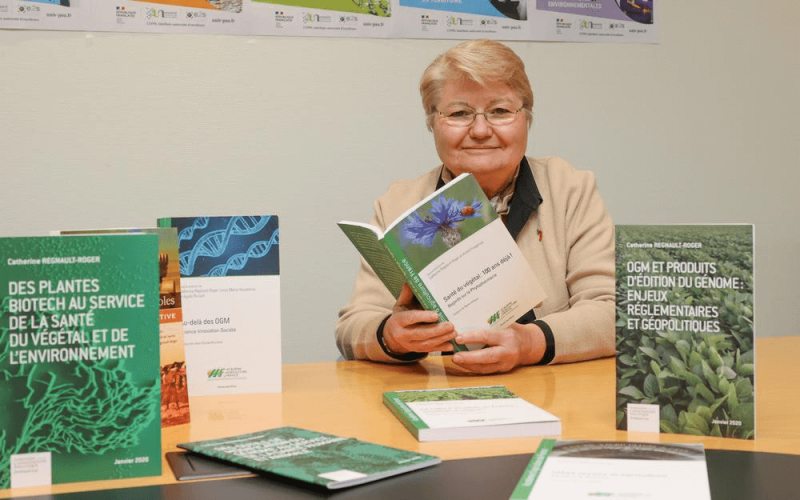
The author alongside previous works. Credit: Jean-Philippe Gionnet

Let’s be frank: Rare are the scientists who have a sense of communication. Catherine Regnault Roger is part of this small group. A pharmacist from Paris 5, and a State Doctor of Natural Sciences from Pierre and Marie Curie University, she is now Emeritus University Professor (E2S UPPA) and a member of the Academy of Agriculture. She is recognized for her research on the bioprotection of agrosystems and the environment through a chemical ecology approach and the sanitary quality of crops (mycotoxins), then for transdisciplinary research on biotechnology and biocontrol… It is therefore difficult to find someone more qualified than her to write a comprehensive book on the “Challenges of biotechnologies, from GMOs to genome editing”

Follow the latest news and policy debates on sustainable agriculture, biomedicine, and other ‘disruptive’ innovations. Subscribe to our newsletter.

In the early 2000s Greenpeace called on a consulting firm to produce a report suggesting investors not to bet on biotechnologies. Those who have followed these recommendations must today bite their fingers because biotechnology is everywhere.

The arrival of the NGT shows us the difference between scientists and ideologues. The former develop their ideas as they improve their knowledge of nature. The latter wait for nature to bend to their ideas. If you want to check for yourself, I urge you to get “Challenges of biotechnologies, from GMOs to genome editing” by Catherine Regnault Roger.

[Editor’s note: This article has been translated from French and edited for clarity.]


This is an excerpt. Read the original post here

{{ reviewsTotal }}{{ options.labels.singularReviewCountLabel }}
{{ reviewsTotal }}{{ options.labels.pluralReviewCountLabel }}
{{ options.labels.noReviewsLabel }}
{{ options.labels.newReviewButton }}
{{ userData.canReview.message }}

Related Articles

Infographic: Global regulatory and health research agencies on whether glyphosate causes cancer

Infographic: Global regulatory and health research agencies on whether glyphosate causes cancer

Does glyphosate—the world's most heavily-used herbicide—pose serious harm to humans? Is it carcinogenic? Those issues are of both legal and ...

Most Popular

Screenshot-2026-07-09-at-1.09.25-PM
Anti-vaccine myths rattle health care
ChatGPT-Image-Mar-10-2026-01_39_01-PM
Viewpoint—“Miracle molecule” debunked: Why acemannan supplements don’t work
Screenshot 2026-07-22 at 1.38
Viewpoint: Are the U.S. and Europe headed towards a repudiation of agricultural biotechnology red tape?
Screenshot 2026-07-28 at 3.22
Hidden hunger: Climate change is speeding up the decline of important nutrients in our food
Screenshot 2026-07-28 at 3.03
What is cyberchondria?
Screenshot 2026-07-28 at 2.04
Viewpoint: How AI supercharges conspiracy theories and oversimplifications to distort online health information
organic scaled
Facts & Fallacies podcast: Organic food cuts pesticide exposure? A response to Dr. Rhonda Patrick
png-terrace-Farm-asia
Europe’s tentative embrace of agricultural gene editing could revolutionize food production and health in Asia
ChatGPT-Image-Jul-9-2026-11_33_49-AM
Viewpoint: High-dose resveratrol supplements to extend health and life? Don’t waste your money.
ChatGPT-Image-May-26-2026-11_51_01-AM
Viewpoint: RFK, Jr.’s depressingly misguided (and litigator-funded) crusade against antidepressants
Screenshot-2026-07-27-at-3.23.14-PM
Prioritizing AI, robotics, and nuclear energy: Trump administration is guiding research funding away from independent universities to private companies
Screenshot 2026-07-28 at 3.43
Fat cat? GLP-1 weight loss drugs for animals are on the horizon
ChatGPT-Image-Jun-25-2026-12_23_17-PM
No, Bill Gates did not secretly engineer ticks to promote veganism
glp menu logo outlined

Get news on human & agricultural genetics and biotechnology delivered to your inbox.